ibigw@ueiibi.com
0086 10 63701497
English
In 2025, China's shipbuilding industry continues to lead the world in three major indicators—
Global shipowners turn to China
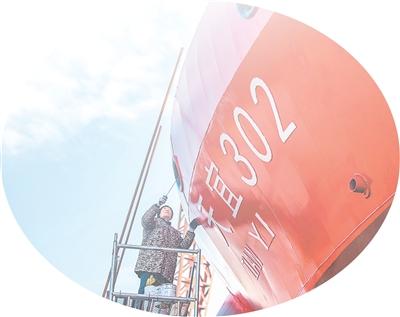
At the shipbuilding site of the Duchang Shipyard in Jiujiang City, Jiangxi Province, workers are engaged in painting operations. Photo by Fu Jianbin (Xinhua News Agency)
In 2025, China's shipbuilding industry once again delivered an impressive report card: the three major indicators of the shipbuilding industry continued to lead the world, maintaining the top position globally for 16 consecutive years.
According to data recently released by the Ministry of Industry and Information Technology, in 2025, China's annual shipbuilding completion volume reached 53.69 million deadweight tons, accounting for 56.1% of the global total; new orders amounted to 107.82 million deadweight tons, accounting for 69.0% of the global total; and order backlog reached 274.42 million deadweight tons, accounting for 66.8% of the global total, setting a new record. These are not just impressive trade figures but also a vivid reflection of China's manufacturing industry deeply integrating into the global industrial division of labor and serving the world economy. From being a "shipbuilding powerhouse" to "serving the globe," China's shipbuilding industry is providing indispensable "Chinese power" to the global shipping industry with an open posture.
Nearly 90% of ships are exported
In 2025, from Europe to Southeast Asia, from North America to the Middle East, international shipowners have been placing orders with Chinese shipyards.
CSSC Guangzhou Shipyard International delivered the first 111,000-ton large LNG dual-fuel crude/product oil tanker "ATLANTIC PEARL" to Singapore's EPS; Shanhaiguan Shipbuilding Industry started construction on an 115,000-ton ice-class product oil tanker for Greece's Dynacom and the first 115,000-ton crude oil tanker for Arcadia; Greek shipowner Danaos and German shipowner Asiatic Lloyd placed orders for 7,100 TEU container ships with CSSC Dalian Shipbuilding Industry Group...
"International shipowners are clearly returning to the Chinese market," said Li Yanqing, Vice President of the China Association of the National Shipbuilding Industry. According to data, in 2025, China's exported ships accounted for 89.6%, 89.5%, and 93.2% of the nation's shipbuilding completion volume, new orders, and order backlog, respectively. This means that for every 10 ships built in China, nearly 9 will serve the global shipping market.
"China's shipbuilding industry achieved remarkable results in 2025, with all three major indicators exceeding expectations," said Li Yanqing. "The future market is expected to develop relatively steadily, so it is crucial for China's shipbuilding industry to continue seizing market opportunities, quickly secure orders, and ensure deliveries."
Why are global shipowners so fond of China?
Speed of construction is one reason. In 2025, CSSC Hudong-Zhonghua Shipbuilding (Group) Co., Ltd. delivered multiple 174,000-cubic-meter LNG carriers for QatarEnergy's "100-ship plan." Saad Sherida Al-Kaabi, Minister of State for Energy Affairs of Qatar, said, "Since the first delivery in 2024, ships have been delivered almost monthly, far exceeding our expectations." This "Chinese speed" has impressed international shipowners.
Another reason is the high overall cost-effectiveness. Zhong Zhechao, founder and CEO of One Shipping, analyzed that after decades of development, China's shipbuilding industry has accumulated mature industrial chain capabilities and strong market competitiveness. Chinese shipbuilding companies can simultaneously provide large-scale construction capacity, reliable delivery capabilities, mature green ship solutions, and supporting financial services, effectively reducing shipowners' comprehensive risks in technology, financing, and delivery.
"There is a consensus in the global shipbuilding industry: at the same technical level, China's shipbuilding costs are the lowest; at the same price, China's delivery capability and reliability are the strongest," explained Zhong Zhechao. Taking Hudong-Zhonghua as an example, its independently developed "Changheng" series LNG carriers control the boil-off rate to within 0.085%. "For the same amount of LNG, Chinese-built ships lose significantly less to evaporation, directly saving money for customers," Zhong said.
Xu Guangjian, a professor in the Department of Public Policy at the School of Public Administration, Renmin University of China, believes that the most critical support factor for China's shipbuilding industry lies in the systemic competitiveness of its entire industrial chain. As the only country in the world with all industrial categories listed in the United Nations' industrial classification, China's manufacturing value-added accounts for 30% of the global total, ranking first globally for 14 consecutive years. A comprehensive industrial system facilitates strong industrial support capabilities and overall cost advantages. "A robust manufacturing system gives Chinese shipbuilding companies exceptional resilience, enabling them to effectively ensure the supply of components and maintain production schedules even amid global supply chain disruptions. This is a key factor that reassures international shipowners," Xu said.
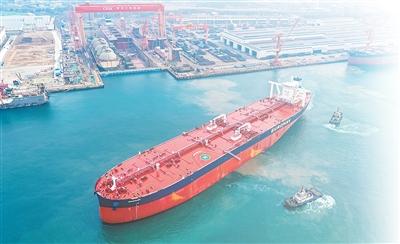
Recently, the 319,000-ton ammonia-ready ultra-large crude oil carrier "EBURONES," built by CSSC Qingdao Beihai Shipbuilding Co., Ltd., set sail from Qingdao, Shandong. This is the second ultra-large crude oil carrier built by Beihai Shipbuilding for Belgium's EURONAV. Photo by Zhang Jingang (Xinhua News Agency)
Systemic competitiveness of the entire industrial chain
China's shipbuilding industry continues to lead the world not only because of the number of orders but also due to its collaborative innovation capabilities across the entire industrial chain and its open posture in serving the globe.
In Dock No. 2 of CSSC Shanghai Waigaoqiao Shipbuilding, the overall progress of the second domestically built large cruise ship "Adora Magic City" has exceeded 91%. Compared to the first domestically built large cruise ship, the construction period has been shortened by nearly eight months. "Now, all scheduling for entry and exit is handled by AI," said Yuan Yi, director of Waigaoqiao Shipbuilding. In the thin plate production workshop, laser cutting and plasma cutting stations are busy, all directed by an "AI brain." Compared to the past when experienced workers arranged production, AI-generated production plans have increased workshop capacity by 25%.
Experts told reporters that as a representative of traditional heavy industry, the deep integration of AI with real-world scenarios has solved challenges such as the complexity of shipbuilding processes and the abundance of materials, bringing about a full-process transformation. In the future, not only domestically built large cruise ships but also various types of ships will see AI integration across design, procurement, production, and logistics, enabling every employee to work alongside "digital employees." This will allow China's shipbuilding industry to not only "build more" but also "build better."
Green transformation is another "Chinese hallmark."
In 2025, as the global shipping industry's green and low-carbon transformation accelerates, Chinese shipbuilding companies have gained a market edge through their forward-looking layout in the field of new energy ships. Data shows that in 2025, multiple world-class green intelligent ships were delivered, achieving significant breakthroughs in high-end transformation and making notable progress in high-quality industry development.
Hudong-Zhonghua delivered the world's first 24,000 TEU LNG dual-fuel ultra-large container ship "CMA CGM Seine," equipped with an 18,600-cubic-meter MARK III membrane fuel tank, capable of providing "green power" for nearly 20,000 nautical miles per voyage. Waigaoqiao Shipbuilding delivered the world's first wind-assisted Aframax product oil tanker "Brentzhatch," equipped with three rigid wing sails, capable of saving 14.5 tons of fuel per day under ideal sea conditions.
"Different countries and regions have varying product demands. For example, the Southeast Asian market focuses more on cost-effectiveness and adaptability, the EU emphasizes compliance and sustainability, while the Americas prioritize automation integration and intelligence," said a CSSC official. Chinese companies are continuing to deepen their globalization strategies, expanding localized services and supply chain systems overseas to gain user recognition.
The collaborative advantages of the industrial chain enhance the competitiveness of China's shipbuilding industry.
On Changxing Island in Shanghai, central enterprises like Hudong-Zhonghua and Jiangnan Shipyard lead over 7,000 supporting companies, forming an ecosystem of "assembly + support." The aforementioned official stated that from ship steel plates to engines, from navigation systems to deck machinery, China has built a complete and independently controllable supply chain system, covering core components, standard products, and solutions.
"In shipbuilding bases like the Yangtze River Delta, we have formed efficient industrial clusters where upstream and downstream companies work closely together, playing an irreplaceable role in reducing logistics and production costs," Xu Guangjian told reporters. Service capability improvement is equally critical. Compared to foreign brands with long accessory supply cycles and high maintenance costs, Chinese shipbuilding companies have advantages in service and responsiveness, with shorter after-sales response times and more flexible engineering support. For global shipping companies, this comprehensive experience of "available, affordable, and quickly repairable" is far more attractive than single performance parameters.
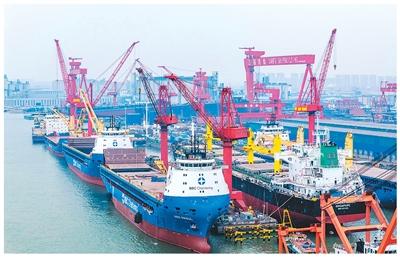
At the production base of Taizhou Sanfu Ship Engineering Co., Ltd. in Gaogang District, Taizhou City, Jiangsu Province, multiple large ships are under construction. Photo by Zhou Shegen (People's Visual)
Towards becoming a "shipbuilding powerhouse"
In China's foreign trade, there are many goods where exports exceed imports. Why is it particularly noteworthy that the three major indicators of the shipbuilding industry have ranked first globally for 16 consecutive years?
"This is not just a change in trade data but also a significant elevation in the global value chain," said Li Yanqing. The shipbuilding industry is a key support for implementing the strategies of becoming a manufacturing powerhouse, a transportation powerhouse, and a maritime powerhouse. China's transformation from the largest ship consumer to the largest global ship supplier signifies that China's manufacturing industry is transitioning from "scale advantages" to "system advantages."
For a long time, countries like South Korea and Japan, with years of technological accumulation and brand advantages, have been the main builders of high-end ships. China's shipbuilding industry has evolved from focusing on bulk carriers and oil tankers to achieving comprehensive breakthroughs in high-end ship types such as LNG carriers, large container ships, and car carriers. Among 18 major ship types, China ranks first globally in new orders for 16 of them, a structural transformation of profound significance.
"China can not only manufacture individual equipment but also export a complete set of replicable and scalable advanced manufacturing capabilities," said Li Yanqing. Upgrading from simple goods trade to comprehensive output of "equipment + solutions + services," China's shipbuilding industry is deeply integrating into the global industrial division of labor, jointly shaping a new industrial pattern of green and intelligent development.
This integration is two-way and mutually beneficial.
For the global shipping industry, the rise of China's shipbuilding industry means more diverse choices and more reliable supply. Against the backdrop of slowing global economic growth, the successful globalization of China's shipbuilding industry demonstrates the resilience and competitiveness of China's manufacturing sector, providing strong support for the stability of global industrial and supply chains.
Data shows that in 2025, six Chinese shipbuilding companies ranked among the world's top 10 in shipbuilding completion volume, new orders, and order backlog. CSSC became the world's largest publicly listed shipbuilding company, holding 18% of global orders, with production schedules extending to 2029. This scale advantage translates into market influence, enabling China's shipbuilding industry to play a leading role in the global shipping industry's green transformation.
For China's manufacturing industry, the high growth of ship exports has driven the coordinated development of upstream and downstream industries.
Shipbuilding involves dozens of industries, including steel, machinery, electronics, and chemicals. A single large LNG carrier requires 25 million components, involving collaboration with over 500 global suppliers. The "going global" of China's shipbuilding industry is essentially the collective "going global" of the entire manufacturing industry chain.
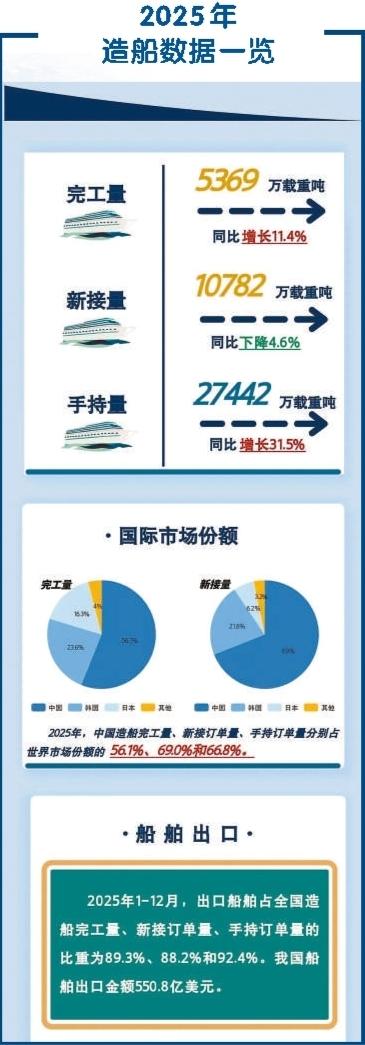
Data source: China Association of the National Shipbuilding Industry
"Having a significant market share in the international market enhances the production scale efficiency of shipbuilding companies, further reducing ship production costs. More importantly, it gives Chinese shipbuilding companies stronger bargaining power and influence in the global shipping industry chain," said Xu Guangjian. "At the same time, with a full order backlog extending to 2028 or even longer, the shipbuilding industry has a stable outlook, allowing companies to confidently invest more resources in upgrading production technologies and optimizing product structures."
Looking ahead, Xu Guangjian pointed out that the biggest challenge for China's shipbuilding industry is how to climb further up the global value chain while maintaining its scale advantage, and how to achieve high quality at competitive prices in the international market. He believes that major shipbuilding companies should continue to increase R&D investment, benchmark against world-class standards, overcome key core technologies, and accelerate the resolution of bottlenecks and pain points in industrial upgrading, achieving a historic leap towards becoming a "shipbuilding powerhouse." (Reporter: Kong Dechen)

 Cross-border