ibigw@ueiibi.com
0086 10 63701497
English
On November 18, the 3rd Belt and Road Conference on Cultural and Technological Integration was successfully held in Changping District, Beijing. The event was co-hosted by the Silk Road Planning Research Center, the China NGO Network for International Exchanges, the Culture Committee of the China Democratic League Central Committee, the China Academy of Arts & Science of China, and the Central University of Finance and Economics. It was organized by the Secretariat of the Belt and Road Conference on Cultural and Technological Integration and Beijing Changping Cultural Tourism Development Group Co., Ltd.
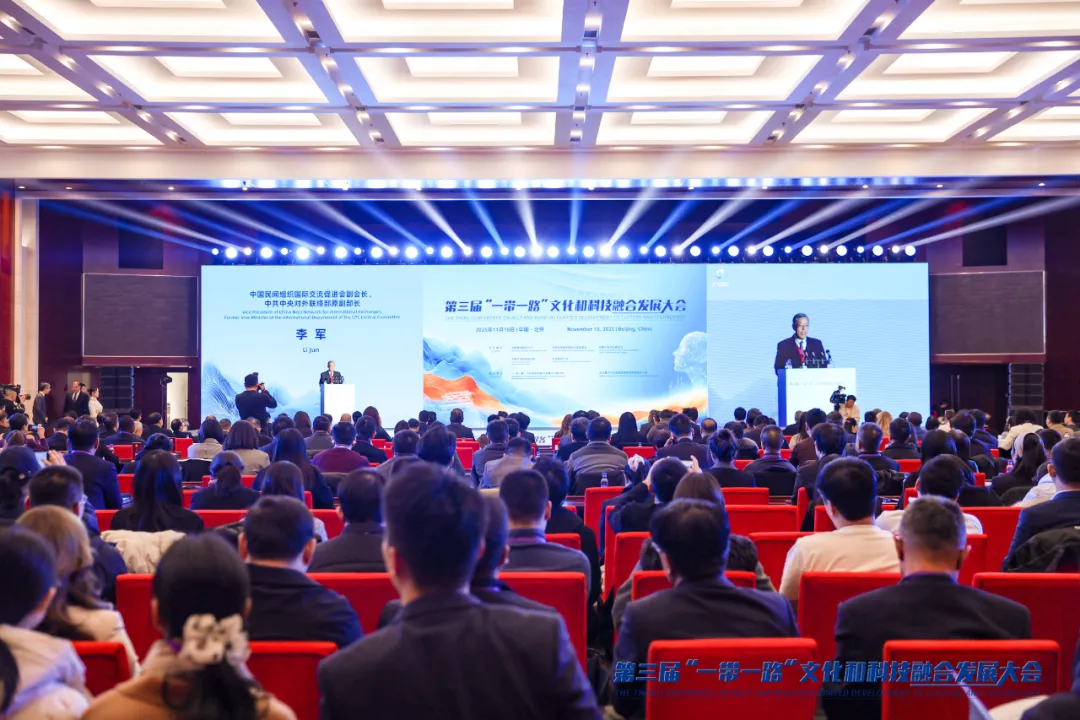
The event brought together scholars, experts, and participants from 15 countries, including Algeria, Egypt, Ghana, Nepal, Saudi Arabia, Türkiye, Italy, Germany, Spain, Indonesia, Lebanon, Pakistan, Brazil, Cambodia, and Mongolia. More than 400 representatives from government departments, international organizations, academic think tanks, cultural and museum institutions, and digital technology companies attended the conference.
Senior national leaders, including Ding Zhongli—Vice Chairman of the Standing Committee of the National People’s Congress and Chairman of the China Democratic League; Sun Dongsheng—Member of the CPPCC Standing Committee and Executive Vice Chairman of the China Democratic National Construction Association; Zhang Qiujian—former Deputy Secretary-General of the 12th CPPCC; and Li Meng—former Vice Minister of Science and Technology, were present at the event.

During the sub-forum on AI-Empowered International Cultural Exchange and Cooperation, Hao Fang, Vice President of IBI and CEO of Wldodo (WLDD), shared WLDD’s innovative practices in applying artificial intelligence to the cultural and tourism industries. Leveraging IBI’s core development strategy of “Platform + Technology + Data,” WLDD integrates AI across the entire value chain, focusing on three major directions: activating IP value, reimagining cultural-tourism experience scenarios, and amplifying digital traffic value. WLDD continues to advance breakthroughs in the areas of “culture & tourism + industries,” “culture & tourism + digitalization,” and “culture & tourism + sports and events,” telling compelling stories of industries, regions, and China through diversified practical approaches.

Hao Fang noted that AI is no longer a cold technological tool, but a warm bridge that preserves culture, connects emotions, and fosters global exchange. She emphasized that IBI will continue working with partners to build a Belt and Road Digital Culture & Tourism Community, creating a globally leading model of integrated industry–culture–sports–tourism development, and injecting sustained momentum into cross-cultural dialogue and industrial cooperation along the Belt and Road.

The 3rd Belt and Road Conference on Cultural and Technological Integration, themed “An International Perspective on the New AI-Driven Cultural-Technology Ecosystem,” highlighted the integration of frontier technologies with cultural innovation. The conference aimed to deepen cultural-tourism development, harness culture to empower socioeconomic progress, promote mutual learning among civilizations, and encourage cultural enterprises and high-quality cultural products to go global. The event not only offered a high-level international platform for cultural-technology collaboration but also infused new impetus into global cultural exchanges through AI and digital culture.
 Cross-border